Proposed EU Public Procurement Regulation: An Extracted Guide to Key Changes
A focused walk-through of the leaked draft Regulation - planning, procedures, supplier access, Green and Social Procurement, innovation, contract governance and professionalisation.
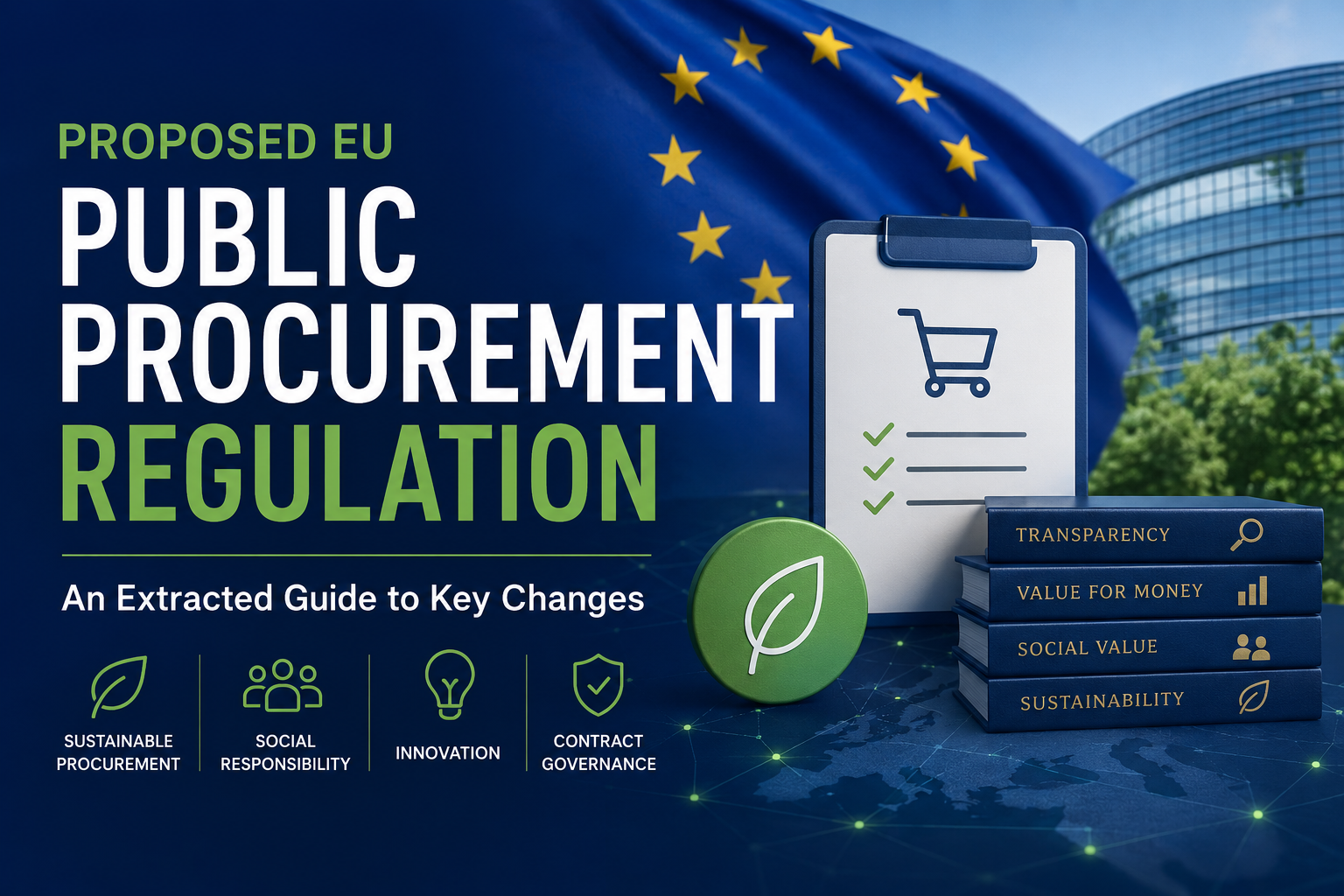
This document provides an extracted guide to the proposed new EU Public Procurement Regulation. It is intended to support an initial understanding of the principal changes and their practical implications for public buyers, economic operators and Sustainable Public Procurement.
The guide focuses on procurement planning, procedural reform, supplier access, Green Public Procurement, Socially Responsible Public Procurement, innovation, contract governance, concessions and professionalisation. It does not cover the draft provisions relating to defence, security, resilience, European preference or the proposed digital and data infrastructure.
As the source document is a leaked draft rather than a formally published or adopted Regulation, its provisions and Article numbering remain subject to change.
Key developments
The proposal signals a substantive re-framing of the EU procurement rulebook - moving from a collection of Directives transposed unevenly across Member States to a single Regulation applied directly, and re-orienting procurement around strategic public value.
| Art. | Description |
|---|---|
| 5 - Strategic Goals | Requires procurement to reflect EU competitiveness, environmental objectives, social inclusion and economic security. |
| 31 - Planning | Requires buyers to publish a Needs Plan at the beginning of each budgetary period. |
| 33 - Choice of Procedures | Establishes when open-negotiated, dynamic simplified, innovation and special procedures may be used. |
| 36 - Open-Negotiated Procedure | Provides for expressions of interest and initial tenders, followed by negotiation or direct evaluation. |
- A single EU framework: the existing procurement Directives would be replaced by one directly applicable Regulation, improving consistency and limiting fragmented national implementation.
- New procurement procedures: the open-negotiated procedure would become the default, supported by a dynamic simplified procedure for recurring off-the-shelf purchases and an innovation challenge procedure for solutions not yet available on the market.
- Earlier procurement planning: public buyers would be required to publish a Needs Plan at the beginning of each budgetary period, improving market visibility and allowing strategic objectives to be considered earlier.
- Improved supplier access: selection requirements would be limited to what is necessary and proportionate, with tighter controls on turnover thresholds and unjustified requirements for previous public-sector experience.
- Stronger environmental integration: environmental considerations could be incorporated throughout the procurement lifecycle, with greater emphasis on circularity, energy efficiency, waste reduction and recycled or refurbished products.
- Defined social outcomes: social inclusion, labour-market integration, quality employment, accessibility, equality, skills development, the social economy and human-rights protection in supply chains are identified as relevant social procurement outcomes.
- Outcome-focused innovation: public buyers could define societal challenges, assess proposed solutions through measurable value frameworks, undertake testing and validation, and procure successfully developed solutions.
- Stronger governance and capability: Member States would designate a national coordinating authority and establish at least one procurement competence centre, with express support for sustainable procurement, needs assessment, market engagement and contract management.
- Greater focus on contract execution: clearer mechanisms for contract-performance conditions, sustainability reporting, performance-linked payments, modification and termination - with more explicit KPI monitoring and corrective-action requirements for concessions.
Sign in to read the full article
SPP Intel is available in full to approved users from Irish public contracting authorities.